Choosing between moissanite and crystal stones trades long-term stone performance against the lowest upfront price. Crystal gives the iced look for less. Moissanite costs more because it is a different material. That difference shows up in sparkle, scratch resistance, testing, and listing accuracy.
Key takeaways
- Moissanite is lab-grown silicon carbide, not glass crystal, and not diamond.
- Moissanite measures 9.25 on the Mohs scale. Crystal is roughly 5.5 to 6, and CZ is roughly 8 to 8.5.
- A basic thermal diamond tester can read moissanite as diamond. A dual thermal and electrical tester separates them.
- In 2026, fully set moissanite watches usually land around $900 to $2,700. Fully iced watches with crystal or CZ stones usually land around $100 to $400.
- If you want the look for occasional wear, crystal can be the smart buy. If you want better stone performance and honest moissanite identity, the higher price makes sense.
Moissanite vs crystal watch at a glance
This comparison is not really about two grades of the same stone. It is about two different materials that happen to be used for the same visual style. Both can look flashy. Only one is actually moissanite.
Moissanite is a lab-grown gemstone. Crystal on stone-set watches is usually a glass-based decorative stone. Some sellers also blur crystal with CZ, which is a separate budget stone. The market mixes these terms more than it should.
| Factor | Moissanite | Crystal watch stones | What it means for you |
|---|---|---|---|
| Material | Lab-grown silicon carbide | Usually glass-based crystal, sometimes loosely grouped with CZ in budget listings | You are not comparing equal stone types |
| Hardness | 9.25 Mohs | Roughly 5.5 to 6 for crystal, roughly 8 to 8.5 for CZ | Harder stones keep their surfaces cleaner for longer |
| Refractive index | 2.65 to 2.69 | No single standard value | Moissanite returns light more strongly |
| Dispersion | 0.104 | No single standard value | Moissanite throws more colored fire |
| Tester behavior | Basic thermal testers often read it as diamond | Does not test as diamond | Tester videos can mislead buyers |
| Typical fully iced watch price | $900 to $2,700 | $100 to $400 | The price gap reflects a real material difference |
What moissanite actually is
Moissanite is silicon carbide. It was first identified in 1893 in a meteor crater by Henri Moissan. Gem-quality moissanite has been lab-grown since the 1990s. In watches, that matters because you are getting a real lab-grown gemstone, not a coated glass stone.
A seller who calls moissanite a diamond is mislabeling it. It is its own stone with its own strengths. For an iced watch, the practical strengths are hardness, light return, and a clearer reason for the higher price.
What crystal means on a stone-set watch
Crystal is a broad market term, not one gem species. On many fully iced watches, it means decorative glass stones chosen to give maximum shine at a low price. That does not make them useless. It just means they sit in a different category from moissanite. Our own budget line carries the name Iced Crystal, which is hand-set crystal and never moissanite.
The word also causes confusion because the window over a watch dial is called a crystal. On our watches, that piece is hardened mineral glass, often called Hardlex. It has nothing to do with the stones set into the bezel, case, dial, or bracelet.
How the two look under real light
Moissanite usually looks sharper and more active under direct light. Its refractive index is 2.65 to 2.69. Diamond sits at 2.42. Its dispersion is 0.104, while diamond is 0.044. Those numbers help explain why moissanite throws so much colored fire.
Crystal stones can still look bright, especially in a fully iced layout with many small stones catching the same light. From a few feet away, or in a quick phone clip, the overall effect can look strong. Up close, the difference usually shows in edge sharpness, depth, and how lively the stones stay as the angle changes.
If you mainly want a stage look, nightlife shine, or the visual effect of a flooded case and bracelet, crystal often delivers enough. If you like inspecting your watch in daylight, moissanite usually gives the more convincing result.
Scratch resistance and long-term wear
This is where the material gap becomes practical. Moissanite sits at 9.25 Mohs. Crystal is roughly 5.5 to 6. CZ is roughly 8 to 8.5. A harder stone resists surface wear better, and that matters when hundreds or thousands of small stones sit on exposed edges.
An iced watch rubs against sleeves, desks, seat belts, and countertops. With crystal, that wear can show sooner as softer-looking facets and a less crisp surface. That does not mean a crystal watch falls apart. It means the stones are working with a lower ceiling for long-term freshness.
If you wear the watch a few times a month, this may not matter much. If you want frequent wear, the stone upgrade becomes easier to justify.
Tester behavior, certificates, and red flags
A standard thermal diamond tester can read moissanite as diamond. That is why so many social videos around stone testing are confusing. A dual thermal and electrical tester separates moissanite from diamond. A loupe can also show moissanite’s double refraction, which looks like slight facet doubling.
The biggest red flag is price. A watch sold as moissanite under about $300 is almost certainly crystal or CZ. The next red flag is vague wording. Terms like diamond tested or VVS look do not identify the material.
If a seller is honest, the listing will name the stone directly and support the claim with a certificate when appropriate. For moissanite, that is much better proof than a quick tester clip.
Price ranges in 2026
The market pricing is actually useful here, because it filters out a lot of bad listings fast. A fully iced watch with crystal or CZ stones usually sits around $100 to $400. Fully set moissanite watches usually sit around $900 to $2,700. Once you move into lab-diamond or natural-diamond work, the budget changes completely.
| Category | Typical 2026 price | What you are usually paying for |
|---|---|---|
| Fully iced watch with crystal or CZ stones | $100 to $400 | The visual look at entry-level cost |
| Fully set moissanite watch | $900 to $2,700 | A real lab-grown gemstone across the full setting |
| Custom lab-diamond bust down | $5,000 to $15,000 | Custom stone setting with lab diamonds |
| Custom natural-diamond set watch | $15,000 to $60,000+ | Custom setting with natural diamonds |
| Factory diamond-set watch from a major house | $40,000 to $250,000+ | Brand premium plus factory diamond work |
This is why the jump between a crystal watch and a moissanite watch is not random. You are stepping from decorative budget stones into a lab-grown gemstone category. That still costs far less than diamond-set territory, but it is nowhere near the same market as a $100 fashion piece.
Weight, comfort, and feel on wrist
Most buyers expect a big weight change when the stones change. In practice, the case and bracelet usually drive wrist feel more than the stone material does. The main difference you notice first is visual. The comfort difference is usually secondary.
If two versions share the same base watch, the fit will feel close. Your decision should center on stone performance, not the idea that moissanite will transform how the watch wears.
That said, expectations matter. People who spend more on moissanite often care more about close inspection. People who buy crystal often care more about look-per-dollar. Those are different buying goals, not better or worse taste.
When a crystal watch is the smarter buy
Crystal is the smarter buy if your budget is capped, you mainly want the iced look, or the watch will be an occasional piece. It also makes sense if you like rotating styles often and do not need the stone itself to be a selling point.
This is the lane for party wear, vacation wear, weekend outfits, and trend-driven purchases. If that matches your use, a piece like the Rainbow, $299, is an honest buy. It gives the fully iced look without asking you to pay for a gemstone category you may not need.
The trade-off is simple. You are buying appearance first, not long-term stone performance first.
When a moissanite watch earns the extra cost
Moissanite earns the extra cost when the stone identity matters to you. It also earns it when you plan to wear the watch often, or when you inspect it close up. The last case is wanting a watch that can be described plainly as moissanite, instead of leaning on vague language.
If that is your lane, browse our moissanite watches and compare them against the lower-priced category side by side. If you want the longer cost-benefit view first, read our guide on whether moissanite watches are worth it.
The money is not buying a little more sparkle. It is buying a different stone class, with the hardness and dispersion figures to match.
Moissanite vs crystal watch in our lineup
Where this becomes easiest to judge is inside the same watch family. In The Mogul, the cleanest apples-to-apples comparison is Rainbow. You are looking at the same core design language with two different stone choices, instead of two unrelated watches.
Rainbow side by side
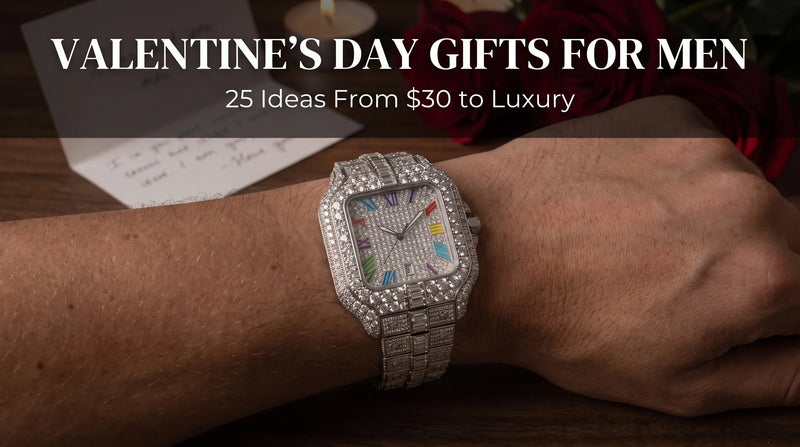
The Rainbow uses a Roman numeral dial with multicolor stone indexes and a fully iced case and bracelet. In the Iced Crystal setting, our hand-set crystal line, it is the Rainbow linked above. In the Moissanite Edition, the direct counterpart is the Rainbow Moissanite Watch, $1,249. That version uses 3,302 moissanite for 19.2 carats total, and it ships with a GRA certificate naming the stones as moissanite.
Both Rainbow versions use a 42 mm case, 10 mm thickness, and a 22 mm band. The clasp is a deployant butterfly clasp. That size is bought by women almost as often as men. It works as a unisex option if you like a larger fit.
If you want a fully iced dial
Ice Royal is the other easy comparison point in The Mogul. Both the crystal and moissanite versions use a fully iced dial, case, and bracelet. The case is 12 mm thick with a 22 mm band, and the clasp is a push-button hidden clasp. If that layout is your priority, compare those two product pages directly.
Other models in The Mogul and The Dynasty also come in crystal or moissanite options, except Ice Baguette, which is crystal only. For those designs, see the product page and compare the stone type first.
How to compare listings without getting fooled
You can screen most listings in under a minute. Start with the material line. If the seller does not say moissanite, crystal, or CZ plainly, keep moving. If the price claims moissanite but sits in obvious budget territory, keep moving again.
- Check the stone name first. Crystal, CZ, and moissanite are not interchangeable terms.
- Check the price against the category. The claim should live in the matching price band, not a costume-jewelry band.
- Check the proof. Look for a certificate that names the stone directly.
- Check the watch specs. Movement, glass type, and water resistance should be listed, not hidden.
- Check the return terms. A stone-set watch is harder to judge from photos alone.
Also watch for language that hides the real comparison. Diamond tested, pass tester, and hand-set luxury style all avoid the key question, which is simple: what are the stones actually made of?
Care, water, and daily use
Any fully iced watch needs basic care. Wipe it after wear. Store it where the stones do not rub against other jewelry. Keep it away from harsh chemicals and blunt impact.
On our watches, the movement is Japanese quartz. Water resistance is 3 ATM, which means rain and hand-washing, not swimming. That limit applies whether you choose crystal or moissanite stones.
If you treat either version like a dressy statement watch, you will get a better result than if you treat it like a sports watch.
Shipping, returns, and warranty
At United Jewel, US shipping is free. Returns are accepted within 14 days, and return shipping is paid by the customer.
Our two-year warranty covers loose stones and the movement. That matters on a stone-set watch, because those are the two service concerns buyers ask about most often.
Frequently asked questions
Which stone looks better up close, moissanite or crystal?
Moissanite usually looks better up close because the facets stay sharper and the light return has more depth as you move the watch. Crystal can still look bright from a short distance, especially on a fully iced design. The closer you inspect it, the more the material gap tends to show.
Why are some watches labeled moissanite under $300?
Most of the time, that price is the warning sign. A sub-$300 watch sold as moissanite is usually crystal or CZ. The other common case is a listing that leans on vague tester language instead of naming the stone. The claim and the price band should agree.
Is the watch crystal over the dial the same thing as the stones?
No. The watch crystal is the clear cover over the dial. The stones are the decorative pieces set into the bezel, bracelet, dial, or case. Those are two separate parts of the watch, even though the same word gets used for both in casual shopping language.
Are the Rainbow crystal and moissanite versions the same size?
Yes. Both versions share the case, thickness, and band width listed above. That makes them useful for a true side-by-side comparison, because the visual difference comes from the stones rather than from a different case shape. Wrist fit should feel close in either version.
Which option is better if I am buying a gift?
If you know the recipient cares about gem type, daily wear, or closer inspection, moissanite is the safer choice. If the main goal is a bold iced look at a lower spend, crystal is usually the practical pick. The right answer depends more on wearing habits than on age or gender.
Can I wear either version every day?
You can wear either one often if you treat it like a statement watch, not a swim or gym watch. The 3 ATM rating covers rain and hand-washing only. For frequent wear, moissanite makes more sense, for the hardness reasons set out above.