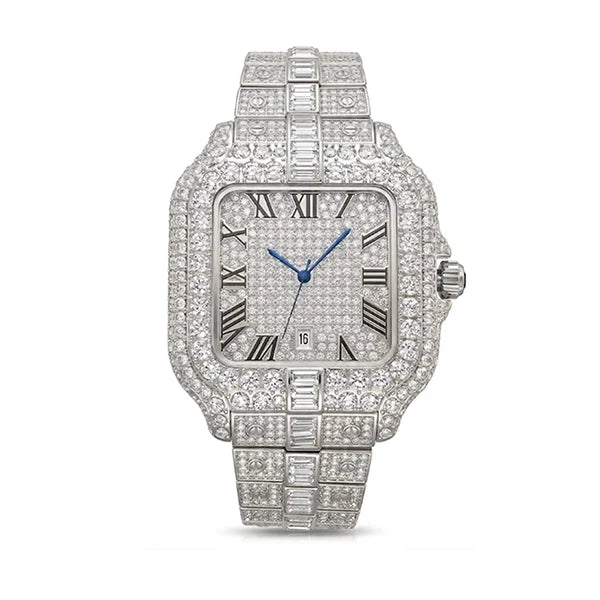
Short answer: a moissanite watch is worth it if you want a fully stone-set watch to actually wear, you are paying between roughly $900 and $2,000 for it, and the seller names and certifies the stone. It is not worth it if you are buying it as an investment, if it costs less than $300 (it is not moissanite), or if what you really want is the word "diamond." Here is the long answer, including the parts sellers usually leave out.
What you are paying for
A moissanite watch is a watch — case, movement, crystal, bracelet — plus several hundred to several thousand small moissanite stones, each cut and set by hand. The stones are the cost. Moissanite is grown in a lab, but it is grown slowly and cut like any gemstone; a fully iced men's watch carries three thousand of them. That is why a genuine moissanite watch cannot be cheap, and why the same design set with crystal is a quarter of the price. Our Rainbow Moissanite is 3,302 stones and 19.2 carats at $1,249; the identical case with hand-set crystal is $299.
The case for: five real advantages
1. It looks like a diamond watch and it keeps looking like one. Moissanite is 9.25 on the Mohs scale and does not cloud, yellow or scratch in ordinary wear. A crystal watch is dull within a year; a moissanite watch at year five looks like it did at week one.
2. The price is a fraction of diamond. Ten to forty times cheaper than a diamond-set watch of the same coverage. That difference is the entire reason the category exists.
3. You will wear it. A $30,000 diamond watch lives in a safe. A $1,249 moissanite watch goes to the office, the airport and the wedding. Jewelry that is worn is worth more to its owner than jewelry that is stored, however the balance sheet reads.
4. More fire than diamond. Moissanite's dispersion is more than double diamond's. On a fully set watch that reads as a brighter, livelier surface — the effect people are actually after when they buy an iced-out piece.
5. No sourcing question. Lab-grown, certified, traceable. No conflict-stone conversation, no mining footprint.
The case against: what nobody puts on the product page
It has no resale value. None of the iced-out watch market does below the diamond tier, and moissanite is no exception. Do not buy one expecting to sell it later for anything close to what you paid.
It is not diamond, and someone will eventually check. A jeweler with a loupe, or anyone with a dual tester, will identify moissanite. If you are going to be uncomfortable when that happens, buy diamond or buy nothing. If you bought it as moissanite and say so, there is nothing to be uncomfortable about.
The watch underneath is usually modest. Most moissanite watches, ours included, use Japanese quartz movements and hardened mineral or sapphire crystal in steel or alloy cases. That is the right engineering for a stone-set watch — thin, accurate, cheap to service — but it is not a mechanical movement, and a watch enthusiast will notice. You are buying jewelry that tells time, not a movement with stones on it.
The plating is the wear item. Gold and rose-gold finishes are plated over steel or alloy. With daily wear, edges and clasp will show it in two to four years. Silver and white finishes age better. This is true of every plated watch at every price; it is the thing to ask about, and the thing warranties do not cover.
Water resistance is modest. 3 ATM on our men's designs, 5 ATM on the women's Liora. Rain and hand-washing, not swimming. A stone-set case cannot be sealed like a dive watch.
Who it is right for
- You want the fully iced look and you will wear it regularly.
- You have a budget of $900–$2,000 and would rather have one honest gemstone watch than three crystal ones.
- You care that the stone is named and certified, and you are fine that it is moissanite.
- It is a gift for someone who will wear it, and "diamond" is not the point of the gift.
Who should skip it
- You want an asset or an heirloom. Buy diamond from a house with a name.
- You want a mechanical movement first and stones second. Buy a mechanical watch.
- Your budget is under $400. Buy the crystal version openly — ours are $299 in the iced out collection — and do not pay $400 for something labelled moissanite that is not.
Cost of ownership over five years
| Item | Moissanite watch ($1,249) | Crystal watch ($299) | Diamond watch ($20,000) |
|---|---|---|---|
| Purchase | $1,249 | $299 | $20,000 |
| Battery / service | $15–30 every 2–3 years | $15–30 every 2–3 years | $300–800 service |
| Insurance | Not needed | Not needed | $200–400 / year |
| Stone replacement | Rare; warranty covers defects | Likely; stones fall and cloud | Rare; expensive |
| Replacement of the watch itself | Unlikely | Likely at year 1–2 | Never |
| Five-year total, approximate | $1,300 | $650–900 (two watches) | $22,000+ |
At a glance
| Moissanite watch | Crystal / CZ watch | Bust-down diamond watch | Entry Swiss watch (no stones) | |
|---|---|---|---|---|
| Price | $900–$1,500 | $100–$400 | $8,000–$40,000 | $1,000–$3,000 |
| Stones keep brilliance | Yes | No (months) | Yes | — |
| Movement | Japanese quartz | Unbranded quartz | Base watch's automatic | Swiss automatic or quartz |
| Warranty | Brand, 2 years | Rarely | Voided by modification | Brand, 2–5 years |
| Resale | Low | None | Low for the modification | Moderate |
| Best for | The iced look, worn daily | A season | Prestige, budget no object | Horology, not sparkle |
The movement question nobody asks
Most "worth it" articles talk about the stones and never mention what is underneath them. Almost every moissanite watch on the market, including ours, uses a Japanese quartz movement — Miyota or Seiko/Epson calibers that cost the maker a few dollars, run within seconds a month and take a battery every two to three years. That is the right engineering for a watch whose value is on the outside: thin, reliable, cheap to replace. It is also why a moissanite watch will never satisfy someone who wants a mechanical movement. Some sellers list "automatic" on sub-$500 iced watches; at that price it is either untrue or an unbranded caliber you will regret. If a mechanical heart matters to you, buy a mechanical watch and a moissanite bracelet.
Plating life, in months, and what re-plating costs
Gold and rose-gold moissanite watches are plated over steel or alloy. With daily wear the clasp underside and case edges begin to show base metal at 18–36 months; with weekend wear, three to five years. Re-plating at a jeweler costs roughly $80–200 for a watch and restores it fully. Silver, white and rhodium finishes wear more gracefully because the base metal is the same color. None of this is covered by any brand's warranty — plating wear is normal use — so factor it into a gold watch's cost of ownership.
Water resistance, honestly
A fully set case cannot be sealed like a dive watch: the stones interrupt the surfaces that gaskets need. 3 ATM (men's designs) and 5 ATM (the Liora) mean rain, hand-washing and sweat. Not showers, not pools, not the sea. Listings claiming 10 ATM on a fully iced case are either measuring the bare case before setting or inventing the number. Keep the crown in, rinse salt off with fresh water, dry it.
What a GRA certificate is — and is not
GRA (Gemological Research Association) issues certificates for moissanite stating stone type, cut, color and clarity grade and total carat weight. It is the standard paperwork for moissanite and it confirms the stone is moissanite and not crystal. It is not an appraisal, not a warranty and not a guarantee of setting quality; a fake GRA card is also the most common trick on marketplace listings, so match the certificate number to the seller's records. Ours ships in the box with the watch, individually numbered for your order.
Carat weight and price per carat
A fully iced 42 mm men's watch carries 15–20 carats of moissanite across 2,500–3,500 stones; the Liora carries 4.18 carats across 426. At $1,249 and $899 respectively that is roughly $65 and $215 per carat — the smaller watch costs more per carat because the case, movement and strap are a larger share of the price. Larger individual stones raise the per-carat cost; that is what you pay for above $1,500. Compare per-carat only within the same case size.
The airport and the tester: the social question
People ask, quietly, whether they will be "caught." Nobody at an airport tests watches. A jeweler with a loupe will identify moissanite in seconds and a dual tester will do it in one; both will also tell you that most of the iced-out watches they see are crystal, and that moissanite is the good news. The only way to be embarrassed by a moissanite watch is to have told someone it was diamond. Bought and described as moissanite, it is a gemstone watch with the paperwork to prove it.
Three-year cost of ownership
| Item | Moissanite ($1,249, gold) | Moissanite ($1,249, silver) | Crystal ($299) |
|---|---|---|---|
| Purchase | $1,249 | $1,249 | $299 |
| Battery (once) | $20 | $20 | $20 |
| Re-plating (once, optional) | $120 | $0 | — |
| Replacement watch | $0 | $0 | $299 (year 2) |
| Three-year total | ≈ $1,390 | ≈ $1,270 | ≈ $620 |
Seven questions to ask before you buy
- What is the stone, exactly? The answer should be one word: moissanite. "Simulated diamond", "diamond-like", "AAA" and "VVS" without a stone name are crystal.
- Is there a certificate, and from whom? GRA or IGI, naming the stone. Ours ships in the box.
- Are the stones set or glued? Hand-set. Glued stones fall out.
- What is the movement? A named Japanese quartz movement is the honest answer at this price. "Automatic" on a sub-$500 iced watch is usually not.
- What is the water rating? 3–5 ATM is normal. Anything claiming 10 ATM on a fully iced case deserves a second look.
- Where is the seller? A physical address, a return policy with a number of days in it, a warranty with a duration. Ours: Brooklyn, 14 days, two years.
- What happens if a stone comes loose? A real answer, not a shrug.
Our honest position
We build moissanite watches and we build crystal watches, and we sell both under their own names. If you want the stone that lasts, the moissanite collection is where the money should go. If you want the look for a season, the crystal versions are the sensible buy and we will not talk you out of them. What we will not do is sell one as the other.
Frequently asked questions
Do moissanite watches hold value?
No. Buy one to wear, not to resell.
How long does a moissanite watch last?
The stones effectively forever. The movement 10–20 years with battery changes. The plating on gold finishes is the first thing to age, typically after two to four years of daily wear.
Is a $300 moissanite watch real?
Almost never. At that price the stones are crystal or cubic zirconia. Ask for the certificate.
Can I swim with a moissanite watch?
No. 3–5 ATM covers rain and hand-washing only.