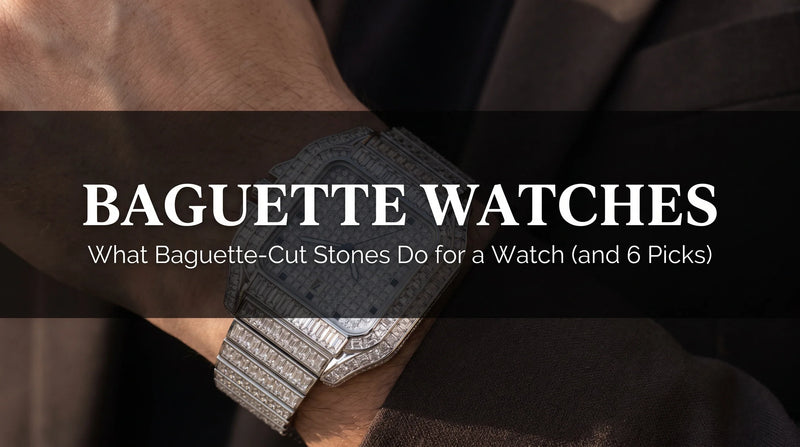
A full iced watch has stones across the dial, bezel, case, and usually the bracelet. A bezel-set piece can still look icy from the front, but it leaves more plain metal visible and usually uses fewer stones. If you’re comparing a full iced watch with a partially set one, focus on coverage, stone size, stone type, and bracelet finish.
Key takeaways
- Full iced usually means the visible top surfaces, and often the bracelet, are set with stones, not only the bezel.
- Stone count rises with more covered areas and smaller stones, but a bigger count does not guarantee better setting quality.
- Bezel-set watches show more metal, feel less dense visually, and usually cost less than a fully iced watch in the same material.
- Stone type sets the tier: moissanite is 9.25 Mohs, crystal is roughly 5.5 to 6, and the price follows.
- Before buying, check the stone type, side and bracelet photos, movement, glass, water resistance, return policy, and any certificate.
What a full iced watch actually means
There is no single industry rule for the term. In practice, buyers use it to mean that the visible top surfaces are set, not just the bezel ring. That usually includes the dial, bezel, lugs, case top, and bracelet links.
Some sellers use full iced more loosely. They may show a fully set bezel and dial, while the sides or bracelet stay mostly metal. That is why side photos matter as much as the straight-on hero shot.
Also, “full” usually refers to what shows on the wrist. The underside of links may stay plain for comfort and service access. That does not cancel the description. It just means coverage is about visible surfaces, not every hidden millimeter.
Bezel-set vs fully iced, the visual difference
A bezel-set watch concentrates sparkle around the crystal. Sometimes the dial is plain. Sometimes it has a few stone markers. The overall look is cleaner because metal still frames the design.
A fully iced watch keeps going past the bezel. The dial is paved. The case shoulders and bracelet continue the effect. From a few feet away, both styles can look bright. Up close, the fully iced piece reads as one continuous surface.
| What to compare | Bezel-set watch | Fully iced watch |
|---|---|---|
| Main covered areas | Usually the bezel, sometimes parts of the dial | Dial, bezel, case top, and usually the bracelet |
| Stone-count direction | Lower, because fewer surfaces are set | Higher, because more surfaces are set |
| Visible metal | More metal remains visible | Less metal remains visible from the top and sides |
| Light pattern | Brighter border around the face | More continuous flash across the whole watch |
| Repair exposure | Fewer setting points | More setting points, so more areas to inspect over time |
| Typical buyer goal | Some shine without full coverage | Maximum coverage and a louder look |
The easy test is simple. Ask yourself where the bare metal still lives. If you can still see wide plain sections on the case and bracelet, you are not looking at a fully iced watch, even if the bezel is dense.
Where stone counts rise and where they do not
Stone count is mostly a math problem. Every new covered surface adds seats. Smaller stones add even more seats. A bracelet can multiply the count faster than the dial because it adds many repeated links.
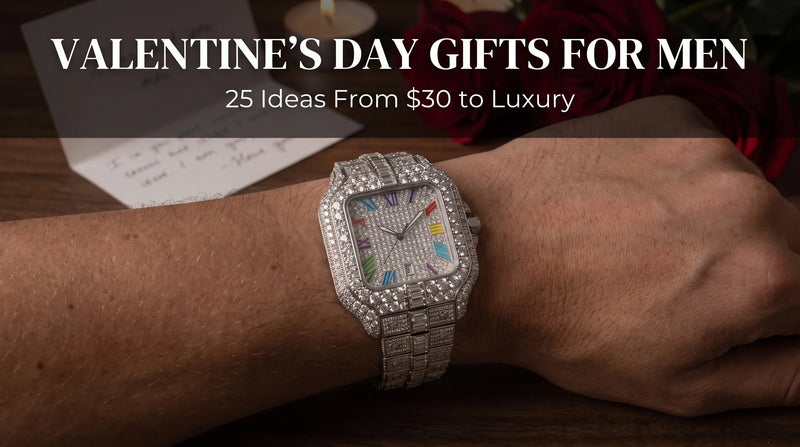
That is why a full-bracelet men’s piece can reach four-digit counts. The Rainbow Moissanite Watch uses 3,302 moissanite, 19.2 ct total. By contrast, our women’s moissanite watches, from $899, use 426 GRA-certified moissanite and leather straps. Smaller proportions and no stone bracelet keep the count lower.
| Design choice | Effect on stone count | Why it changes |
|---|---|---|
| Dial only | Lower | The setting area is limited to the face |
| Add the bezel | Higher | The outer ring creates another full row set |
| Add lugs and case top | Higher again | More pave seats are cut into the case |
| Add the bracelet | Big increase | Each link adds repeat setting area |
| Use smaller round stones | Often higher | More stones fit into the same space |
| Use larger stones or baguettes | Often lower | Each stone covers more area by itself |
| Use a leather strap | Much lower | The strap carries no stone count at all |
This is why stone counts only make sense when the designs are similar. Comparing a full bracelet watch to a leather-strap watch is not a fair count contest. Comparing round pave to baguette layouts is not fair either.
Stone count is not quality by itself
The watch with more stones is not automatically the better watch. Stone count only tells you how many seats were filled. It says nothing about row symmetry, size matching, or how securely each seat was cut.
Look for even spacing around the bezel. Look at the first bracelet links near the case. If table heights jump around, the watch can look rough up close. If the lines stay straight, the setting looks cleaner even before light hits it.
More stones also mean more hours at the bench. Count becomes useful only after you understand coverage, stone size, and the quality of the setting work.
How stone type changes the look and price
Coverage tells you how much of the watch is set. Stone type tells you what tier you are buying into. Those are separate decisions, and many shoppers mix them together.
| Watch category | Typical 2026 US price range | What you are usually paying for |
|---|---|---|
| Fully iced watch with crystal or CZ stones | $100 to $400 | Budget fashion coverage |
| Fully set moissanite watch | $900 to $2,700 | Lab-grown moissanite across the case and bracelet |
| Custom lab-diamond bust down | $5,000 to $15,000 | Aftermarket lab-diamond setting work |
| Custom natural-diamond set watch | $15,000 to $60,000+ | Aftermarket natural-diamond setting work |
| Factory diamond-set watch from a major house | $40,000 to $250,000+ | Brand-made diamond-set production watch |
Moissanite is lab-grown silicon carbide. It sits at 9.25 Mohs. Diamond is 10. CZ is about 8–8.5. Crystal or glass is roughly 5.5–6.
Moissanite also has different optical numbers. Its refractive index is 2.65–2.69, against 2.42 for diamond. Its dispersion is 0.104, against 0.044 for diamond. That is why it lives in a different visual tier than basic crystal.
If you want that material across different styles, browse our moissanite watches. If a watch is sold as moissanite under about $300, it is almost certainly crystal or CZ.
What a fully iced out watch feels like on the wrist
A fully iced out watch announces itself before anyone reads the dial. That is the point for many buyers. It is not the right mood for every room, and that is worth deciding before you pay for maximum coverage.
On the wrist, the bigger change is visual mass, not just physical weight. The bracelet flashes from more angles, and sleeves can catch on the profile sooner. A bezel-set watch usually blends more easily with plain clothes because more metal breaks up the surface.
Comfort also depends on bracelet articulation. A full bracelet piece needs clean link movement and a good fit. If the bracelet is too loose, the watch rolls and the top-heavy look becomes more obvious.
Case size, thickness, and daily wear
Stone coverage can make a watch look larger than the same case in plain steel. The eye reads sparkle as surface area. That matters if your wrist is slim or you wear narrow cuffs.
Thickness matters too. A watch can be fully iced and still wear flatter than another design with less coverage. The listing should show thickness and band width, not only face diameter. Those numbers affect daily comfort more than the word full.
Think about your usual clothes. Full coverage under a hoodie is easy. Full coverage under a fitted shirt cuff takes more planning. That is not a flaw. It is part of what you are buying.
How to read listing photos and videos
Start with the side profile. A true full-coverage piece should show setting work beyond the top ring. Then inspect the bracelet edges and the first links near the case. Those areas reveal whether coverage is continuous or only front-facing.
Look for static photos in normal light. Over-edited clips can hide gaps, mixed stone sizes, or dead zones between links. A moving wrist shot helps when it shows real articulation and real lighting, not only tight cropped flashes.
Also look for straight rows around the bezel and clean transitions at the lugs. If the camera never shows the bracelet opened or bent, ask why. The bracelet is where a lot of the stone count and a lot of the labor actually live.
What to check before you buy
- Stone type. The listing should say moissanite, crystal, or CZ, not just “iced.”
- Coverage. Ask whether the dial, bezel, case top, sides, and bracelet are all set.
- Stone count. Make sure the count belongs to the exact design you are viewing.
- Movement. A seller should tell you whether the watch is quartz or mechanical.
- Glass. The crystal over the dial should be named clearly, not left vague.
- Water resistance. The rating should be translated into real use, not left as a bare number.
- Returns and warranty. Read what is covered for loose stones, movement issues, and buyer-paid return shipping.
- Certification. If the watch is sold as moissanite, ask whether a certificate comes with it.
That checklist sounds basic, but it filters out most weak listings fast. A good product page should answer these points without forcing you to guess from photos.
Where this applies to our lineup
In our men’s range, the clearest full-coverage examples sit in the men’s Moissanite Editions and the broader iced out watches collection. A direct example is the Ice Royal Moissanite Watch, $1,249.
It has a fully iced dial, case, and bracelet. It is 12 mm thick, uses a 22 mm band, and closes with a push-button hidden clasp. Across our men’s models, case size is 42 mm. Movement is Japanese quartz. The crystal is hardened mineral glass, often called Hardlex.
Full Ice is also available in both stone types, $299 in the Iced Crystal setting and $1,249 as a Moissanite Edition. See the product page for its design details. If you are choosing between front-only sparkle and full coverage, this is the point in the lineup where that choice becomes obvious.
Iced Crystal vs Moissanite Edition in our lineup
We sell two stone types, and the product name tells you which is which. Iced Crystal is the hand-set crystal budget line at $299. Moissanite Edition is $1,249 in the men’s range. Every moissanite watch ships with a GRA certificate naming the stone as moissanite.
Choose Iced Crystal if you want the full look at $299 and accept a crystal stone. Choose Moissanite Edition if you want lab-grown silicon carbide and the certificate that names it. For a broader cost and trade-off breakdown, read our guide on whether moissanite watches are worth it.
The practical point is simple. Coverage answers how much of the watch is set. Stone type answers what the stones actually are. You need both answers before a price means anything.
Common buying mistakes
- Confusing coverage with material. A watch can be fully iced and still use budget stones.
- Comparing counts without matching designs. Stone count only compares cleanly when size, strap type, and stone shape are similar.
- Judging from one front photo. Side views and bracelet shots tell you whether the watch is truly full coverage.
- Chasing the biggest count. A cleaner lower-count setting can look better than a crowded higher-count layout.
- Ignoring the bracelet. On a full iced watch, the bracelet is not an accessory. It is a large share of the labor and the visual effect.
- Forgetting daily use. If you want one watch for every outfit, a bezel-set piece may be the smarter first buy.
Most regret comes from buying the name of the style instead of the actual build. Read the listing like a checklist. If the seller is vague about material, coverage, or service terms, assume you are the one filling in the blanks.
Shipping, returns, warranty, and care limits
These are the United Jewel terms. We offer free US shipping. Returns are accepted within 14 days, and the customer pays return shipping. Our two-year warranty covers loose stones and movement.
Water resistance is 3 ATM. That means rain and hand-washing, not swimming. Treat a full-coverage watch like jewelry as well as a watch. Avoid hard knocks, and dry it after splashes.
Who should buy a full iced watch
A full iced watch makes sense if maximum coverage is the goal. It also makes sense if you already know you prefer a louder watch and you want the bracelet to matter as much as the bezel.
- Choose full iced. You want the dial, case, and bracelet to read as one bright surface.
- Choose full iced. You wear the watch for nightlife, events, content, or outfits built around statement accessories.
- Choose bezel-set. You want sparkle at the face but more plain metal around it.
- Choose bezel-set. You are buying your first iced piece and want an easier daily option.
If you are still unsure, start by asking one question. Do you want light concentrated around the face, or across the whole watch? Once you answer that, the rest of the decision gets much easier.
Related guides
- Iced Out Watches for Men: The Honest 2026 Guide (Crystal, Moissanite, Diamond)
- Real Iced Out Watches vs Fake: 9 Ways to Tell Before You Pay
Frequently asked questions
Does a full iced watch always have a higher stone count than a bezel-set watch?
Usually, yes, because full coverage adds the dial, case, and often the bracelet. It is not automatic, though. Larger stones, baguette layouts, or a partially set bracelet can lower the count. Compare the covered surfaces first, then compare the number.
Why can two full iced watches have very different stone counts?
Stone count changes with case size, strap type, stone size, and stone shape. A leather-strap watch has no bracelet count at all. A full bracelet watch can add hundreds or thousands of seats. Smaller pave stones also push the count up faster than larger stones.
How do I verify that a full iced watch uses moissanite?
Look for the stone name in the listing and ask whether a certificate is included. A basic thermal pen often reads moissanite as diamond. A dual thermal and electrical tester is better, and a loupe can reveal double refraction through facet doubling.
Is a full iced watch practical for daily wear?
It can be, if you like a larger visual footprint and more attention on the wrist. Quartz timekeeping keeps ownership simple. The bigger trade-off is styling, not function. If you want something easier to pair with every outfit, bezel-set is usually the calmer choice.
Can I shower or swim in a full iced watch?
For our men’s lineup, no. The rating is 3 ATM, which covers rain and hand-washing only. Swimming adds more water pressure and more exposure around the case and bracelet. Dry the watch after splash contact and keep it out of the pool.
Is a 42 mm full iced watch only for men?
No. Wrist size and style preference matter more than the label. In our lineup, the Rainbow is bought by women almost as often as men. If you like the scale and want a bold look, a 42 mm full-coverage watch can work as a unisex choice.