Cheap iced out watches span several categories. The jump from $100 to $1,000 changes the stones, build, and expectations. The smart move is to buy for the right purpose, not the lowest sticker. Around $100 usually buys flash for occasional wear, $300 can buy a credible everyday piece, and $1,000 opens the door to real moissanite.
Key takeaways
- $100 usually buys crystal or CZ, with more risk in finishing, stone security, and bracelet feel.
- $300 is the first tier where many affordable iced out watches start feeling wearable, giftable, and honestly priced.
- Fully set moissanite watches usually run $900 to $2,700, not fashion-watch prices.
- A watch advertised as moissanite below about $300 is almost certainly crystal or CZ.
- Buy by use case first, occasional flex, everyday wear, or long-term stone quality.
Cheap iced out watches are not all the same
The phrase covers several very different products. Some pieces are simple fashion watches with bright stones and basic metal. Some are better-made watches with hand-set crystal or CZ stones. Some are true moissanite watches, which live in a different budget lane.
Photos hide a lot of that. Under direct light, crystal, CZ, and moissanite can all look loud for a second. The real gap shows up later, in scratches, stone security, case feel, and how convincing the watch looks at arm’s length.
That is why this price question matters. A buyer who wants one watch for nights out can shop differently from a buyer who wants a daily piece. The worst mistake is expecting a $100 watch to perform like a $1,000 watch, or expecting a $1,000 watch to be diamond.
What you usually get at $100
At $100, compromises are normal. The stones are usually crystal or CZ. Finishing can be rougher, plating can look thinner, and the bracelet may feel lighter than the photos suggest.
That does not make the category useless. A $100 iced watch can work for a party, a birthday outfit, a video shoot, or a trend test. It just belongs in the occasional-wear lane, not the long-haul lane.
You should also expect more variance. One watch can look decent in person, while another at the same price can arrive with uneven stone spacing or a weak clasp. That is why material disclosure matters more here than brand storytelling.
When you shop this tier, look for clear case material, close-up images, and a return window you can live with. If the listing hides the stone type or avoids direct wrist photos, the low price is not the only problem.
Why stones matter more than photos
The stone is the biggest reason cheap iced out watches can feel smarter than they are, or cheaper than they looked online. Here is the honest difference between the three materials shoppers see most often.
| Stone type | What it is | Hardness | Common price band for iced watches | What buyers notice |
|---|---|---|---|---|
| Crystal or glass | Man-made crystal or glass stone | About 5.5–6 Mohs | $100 to $400 | Bright at first, lowest cost, scratches sooner |
| CZ | Cubic zirconia | About 8–8.5 Mohs | $100 to $400 | Good flash, still a budget stone, heavier feel |
| Moissanite | Lab-grown silicon carbide | 9.25 Mohs | $900 to $2,700 | The strongest flash of the three, and the highest price |
Moissanite has a refractive index of 2.65–2.69 and dispersion of 0.104. Diamond sits at 2.42 and 0.044. That is why moissanite throws more rainbow flash.
The lesson is simple. Stone type is not a tiny detail buried in the specs. It is the main reason a watch lands at $100, $300, or $1,000 in the first place.
What changes at $300
The biggest upgrade around $300 is consistency. The stones can be set more evenly, the case shape can look cleaner, and the bracelet usually feels less disposable. You are still shopping a value tier, but the watch can start feeling intentional.
This is where affordable iced out watches begin to make sense as real purchases, not just impulse buys. A good $300 watch can look right from normal distance, hold up for regular use, and avoid the toy-like feel that hurts cheaper pieces.
What $300 usually does not buy is full moissanite. In this bracket, you are normally paying for better execution inside the crystal or CZ category. That is still a valid buy if the seller says so clearly.
This is also the tier where gifting gets easier. The watch can feel presentable out of the box, and the tradeoffs are easier to explain. You are buying the iced look honestly, without pretending the stones are something rarer.
Cheap iced out watches at $300 versus $1,000
The gap between $300 and $1,000 is not only about looking shinier. It is about moving from budget stones to a gem material that changes durability and optics. That is why the jump feels large in price and in product truth.
| What changes | $100 | $300 | $1,000 |
|---|---|---|---|
| Stone type | Usually crystal or CZ | Usually better crystal or CZ execution | Real moissanite becomes realistic |
| Case and bracelet feel | More variance, more shortcuts | Can feel solid and wearable | Should feel serious, not novelty-level |
| Use case | Occasional wear | First real iced watch, gifting, regular rotation | Stone-first buyer, longer-term keep |
| Main risk | Overpaying for weak build | Expecting moissanite at crystal pricing | Assuming moissanite means diamond |
| Honest takeaway | Buy for the look only | Best value point for many shoppers | Buy when stone material matters |
At $1,000, you are still far below custom diamond territory. Custom lab-diamond bust downs usually land at $5,000 to $15,000. Custom natural-diamond set watches sit around $15,000 to $60,000+, and factory diamond-set watches from a major house often run $40,000 to $250,000+.
The hard truth is simple. A watch sold as moissanite under about $300 is almost certainly crystal or CZ. If you want the wider market view, read our guide on moissanite watches under $1,000.
The specs that decide daily wear
Stone type gets the headline, but daily wear comes down to a few practical specs. These details are what separate a fun purchase from a frustrating one.
Case material and bracelet
Stainless steel is safer than vague wording like “metal.” It usually holds shape better and feels more substantial on wrist. If the material is not named, treat that omission as information.
Movement and glass
A quartz movement is normal in a value iced watch. That is often the right call if you want low fuss and steady timekeeping. Hardened mineral glass is a sensible middle point when sapphire is not part of the deal.
Water rating and thickness
Water resistance language gets abused in this category. A 3 ATM rating means rain and hand-washing, not swimming. Thickness matters too, because a fully set bezel and bracelet can feel bulky if the watch is already tall.
Clasp and stone layout
Check the clasp on the product page, even if the photos focus on the dial. Cheap bracelets often fail at the clasp before the case looks old. Also check whether the stone pattern looks planned, not random.
How an iced watch will look on your wrist
A fully iced watch wears larger than a plain watch with the same case size. Stones on the bezel and bracelet reflect light across the whole top surface. That makes the watch read broader from a few feet away.
That is why you should check more than the case number. Look at thickness, bracelet width, how much dial space is left once stones surround it, and whether the bracelet tapers. A wide bracelet with little taper can feel like a cuff, even if the case itself is reasonable.
Use wrist photos, not only flat lays. If the seller shows the watch only tilted toward the camera, you still do not know its real wrist presence. If you want subtle, skip the fullest stone layouts.
If the point is presence, the larger visual footprint may be right. The key is buying the look you actually want, not the one the lighting suggested.
Red flags before you buy
Most disappointment with cheap iced out watches starts before checkout. The warning signs are usually visible if you slow down for one minute.
- “Moissanite” at fashion-watch prices. Real moissanite has a known market range, and the numbers do not support $99 fantasy listings.
- No case material listed. If the page never says stainless steel, alloy, or anything specific, the seller is hiding something basic.
- Only heavily edited photos. You need normal wrist shots and clear close-ups, not only extreme flash under jewelry-store lighting.
- No clear returns or warranty language. A low price does not help much if you cannot send the watch back or fix a loose stone.
- Diamond tester talk as the whole pitch. Basic thermal pens can read moissanite like diamond. Dual thermal and electrical testers separate them. A loupe can reveal facet doubling in moissanite, which is a better clue than tester talk alone.
None of these signs guarantees a bad watch. Together, they tell you the seller cares more about the first click than the watch after week one.
Who each budget fits
The right budget depends on why you want an iced watch. The smart buy for one person can be dead money for another.
$100 fits the trend tester
Buy here if you want one specific look for a few events. This tier works when the goal is style, not durability. Keep expectations narrow, and you can still be happy.
$300 fits the first serious buyer
This is the value sweet spot for many shoppers. You can get a fully iced look that feels presentable and believable, without paying for a gem material you do not actually need.
$1,000 fits the stone-first buyer
Move up when the stones are the point. If you care about hardness, wear resistance, or owning real moissanite, this is where the search becomes rational. Below that, most full iced listings are still working in the crystal or CZ lane.
Where The Mogul fits
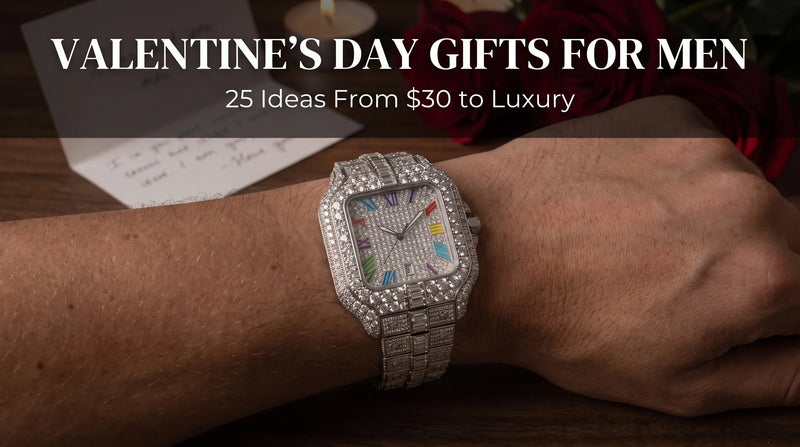
At United Jewel, this price lane is where The Mogul makes sense. The clearest example is the Rainbow at $299. It has a 42 mm stainless steel case and bracelet. The dial uses Roman numerals and multicolor stone indexes. The case and bracelet are fully iced. It uses Japanese quartz, hardened mineral glass, and 3 ATM water resistance. Thickness is 10 mm, band width is 22 mm, and the clasp is a deployant butterfly style.
It sits in our Iced Crystal line, not in moissanite. That is why the price stays in the honest crystal bracket instead of pretending to be something else. If your goal is the iced look first, that logic holds up.
The strength of this tier is balance. You can get a watch that reads as a designed piece, not just a base watch covered in shine. If you want a different look from The Mogul, compare the collection page and judge the dial and stone layout that suits you best.
When to stretch to moissanite
Stretch when the stone material matters more than the silhouette. Moissanite is lab-grown silicon carbide with 9.25 Mohs hardness. That is a real material jump, not a tiny cosmetic upgrade.
The difference shows up in wear resistance and optical performance. If that matters, browse our men’s Moissanite Editions. If you want the tradeoffs in plain language, read our guide on whether moissanite watches are worth it.
Do not stretch just for status. Stretch if you keep watches a long time, care about stone durability, or want a fully set watch priced in the real moissanite lane. If none of those points matter, a strong $300 crystal watch can be the smarter buy.
One better watch or several cheaper ones
Sometimes yes. If you already know you want the iced look in regular rotation, one solid watch usually beats a drawer of near-misses. You learn its fit, you wear it more often, and the cost per wear stops looking high.
Several cheaper watches make more sense when you are still testing the style. They also work if you want different case colors for specific outfits and do not care whether any one piece lasts for years. That is a wardrobe decision, not a quality decision.
The mistake is buying three low-tier watches when what you really wanted was one credible piece. In that case, saving once and buying better is usually cheaper than replacing disappointment.
The reverse mistake happens too. If you know you will wear an iced watch twice a year, a carefully chosen crystal piece can be rational. Stretching just to own moissanite may not add much value for you.
Shipping, returns and warranty
If you are buying online, the policy matters almost as much as the watch. We offer free US shipping on every order. Returns run 14 days, and the customer pays return shipping.
Our two-year warranty covers loose stones and movement. Every moissanite watch ships with a GRA certificate that names the stone as moissanite. If you want to compare starting points, browse the iced out watches collection, where Iced Crystal models are $299.
Related guides
- Iced Out Moissanite Watches: What 'Fully Iced' Really Means and What It Costs
- Iced Out Watches for Men: The Honest 2026 Guide (Crystal, Moissanite, Diamond)
- Real Iced Out Watches vs Fake: 9 Ways to Tell Before You Pay
- Rainbow Iced Out Watches: The Multicolor Trend Explained
- Iced Out Watches for Women: Sizes, Styles and 10 Picks
Frequently asked questions
Are cheap iced out watches good for daily wear?
They can be, if the seller discloses materials clearly and the case, bracelet, and stone setting look consistent in normal photos. At the very lowest end, occasional wear is the safer expectation. Better-executed watches usually feel less flimsy and age more predictably.
Why do some low-price listings use the word moissanite?
Because it draws attention. Read the materials line, then ask whether the watch is fully set or only uses moissanite in limited accents. Look for a certificate that names moissanite when the claim is central. Vague wording is usually the bigger warning sign.
Can I start with a crystal watch and upgrade to moissanite later?
Nothing stops you. Many shoppers buy a crystal version first to test the look, then move to moissanite once they know they will wear it. Our designs overlap across both stone types. The second watch can be the same silhouette with a different stone. The first one can stay in rotation or become a gift.
What makes an iced watch giftable when the budget is tight?
Clear material disclosure, a clean stone layout, and a return policy the recipient can use matter more than extra marketing language. A watch can be a good gift without being moissanite. It just needs to look intentional in person and arrive with honest specs.
How can I judge size if I cannot try the watch on?
Use wrist photos first, then check case size, thickness, and bracelet width together. A fully iced bezel and bracelet create a larger visual footprint than plain metal. If the listing avoids straight-on wrist shots, you still do not know how the watch will actually wear.
What should I check first on a budget iced watch listing?
Start with stone type and case material. Then check the return window, normal close-up photos, movement, glass, and water rating. If the page hides the basic materials or leans only on lighting tricks, move on before price talks you into a weak buy.