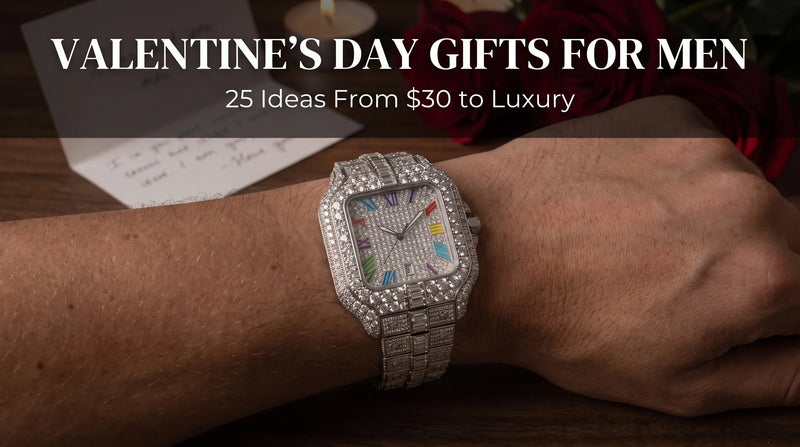
A bust down watch is a standard watch that has been covered in stones after production. The term usually means custom setting on the bezel, case, bracelet, dial, or all four. If you want the look without custom diamond pricing, a moissanite version is the category to compare first.
Key takeaways
- A bust down watch usually means a watch that was stone-set after it was made, although many shoppers use the term for any fully iced watch.
- Price is driven by stone material, stone count, coverage, labor quality, and whether the piece is custom or ready-made.
- In 2026, fully set moissanite watches usually land from $900 to $2,700, while custom diamond work starts much higher.
- Moissanite is not diamond. It is lab-grown silicon carbide at 9.25 Mohs, and an honest listing names it as moissanite.
- The safest buy is a watch with clear stone naming, realistic pricing, return terms, and warranty details you can read before checkout.
What a bust down watch actually means
A bust down watch starts as a normal watch. After that, stones are set into visible surfaces until the watch looks iced out. Some jobs cover only the bezel and lugs. Others cover the bracelet links and dial too.
Purists use the term for aftermarket work. Many shoppers use it for any fully iced watch, even when the piece was designed and set that way from the start. For buying decisions, the bigger question is simpler. Do you want custom one-off work, or do you want the bust-down look at a known price?
That distinction matters because photos can look identical while the buying experience is not. Custom work can cost more, take longer, and offer fewer return options. A ready-made moissanite model can give the same visual effect without the uncertainty.
How the stone setting is done
Stone setting on a watch is tighter work than stone setting on a ring. A bracelet has moving links, a case has curves, and a dial leaves little room for error. Small mistakes show up fast once the watch hits daylight.
Metal has to be prepared for each stone. Sizes must be matched closely. Then each stone is secured by hand, and the watch is reassembled and checked. The more coverage you want, the more labor hours pile up.
A clean result depends on layout as much as material. Uneven rows, loose stones, and crowded edges are easy to spot. That is why labor is a major part of price, even before you talk about diamond versus moissanite.
Why some bust downs cost far more than others
Most price gaps come from six variables. They are the base watch, stone material, stone count, layout complexity, metal preparation, and who is doing the work. A simple bezel job is cheaper than a dial, case, and bracelet job.
Diamond raises material cost first. Moissanite lowers the stone bill, but it does not erase setting labor. A dense field of small, well-matched stones still takes time. Cheap stones cannot hide weak workmanship.
Shape also matters. Straight rows across a flat surface are simpler than tight curves, mixed shapes, or difficult bracelet links. Better finishing adds more time again. Consistency is expensive because matching small stones well is slow work.
Custom work adds design risk too. If the setter has to alter an existing watch, service later can become more complicated. That risk is part of what you pay for, even before stone quality enters the picture.
Bust down watch prices in 2026
The US market splits into clear bands. Those bands matter because sellers often place very different products next to each other in photos. The table below is the realistic range for 2026.
| Category | Typical 2026 US price | What you are usually paying for |
|---|---|---|
| Fully iced watch with crystal or CZ stones | $100 to $400 | Fashion look at the lowest stone cost |
| Fully set moissanite watch | $900 to $2,700 | Real moissanite and dense hand setting |
| Custom lab-diamond bust down | $5,000 to $15,000 | Higher stone cost and custom labor |
| Custom natural-diamond set watch | $15,000 to $60,000+ | Natural stones, custom labor, expensive starting point in many cases |
| Factory diamond-set watch from a major house | $40,000 to $250,000+ | Factory setting and house-level pricing |
The market ranges look wide because this category spans fashion jewelry and fine jewelry at once. A crystal piece can look flashy in photos. It does not cost like the bands above it, and it does not wear the same way.
If a watch is sold as moissanite under about $300, it is almost certainly crystal or CZ. If you want the lower end of the look, see our fully iced watches with crystal or CZ stones at $299. If you want a gem-grade stone, the next band starts much higher for a reason.
Stone materials compared
The stone choice changes not only price, but also how the watch ages. This is where many shoppers make the wrong comparison. They compare sparkle in a short video instead of comparing the material itself.
| Material | Hardness | What it is | Where it sits in the market |
|---|---|---|---|
| Moissanite | 9.25 Mohs | Lab-grown silicon carbide, refractive index 2.65–2.69, dispersion 0.104 | Mid-market fully set watches |
| Diamond | 10 Mohs | Refractive index 2.42, dispersion 0.044 | Custom and factory high-price category |
| CZ | About 8 to 8.5 Mohs | Budget simulant used for shine | Low-cost iced watches |
| Crystal or glass | About 5.5 to 6 Mohs | Cut glass used for shine at the lowest cost | The cheapest iced watches |
Silicon carbide was first identified in a meteor crater in 1893. Gem-quality growing started in the late 1990s, which is why the stone is now common in watches. It is not diamond, and we do not label it as diamond.
The dispersion figures in the table explain the daylight difference. Higher dispersion means more colored flash, so a fully set moissanite watch reads more rainbow than a diamond one. The hardness column shows the same gap against CZ and crystal.
How to tell what the stones really are
The easiest test is paperwork before gadgets. The product page, invoice, and certificate should say moissanite if the stones are moissanite. Vague words like “simulated” or “diamond tested” are not enough if you are paying moissanite money.
A thermal pen tester can read moissanite as diamond. That is normal. A dual thermal and electrical tester can separate them. Tester videos are useful only when you know which tool is being used.
A loupe can also help. Moissanite shows double refraction, which can look like slight facet doubling. If you want the deeper comparison, read our moissanite versus diamond watch guide. It explains where moissanite and diamond overlap, and where they do not.
Our moissanite watches ship with a GRA certificate that names the stone as moissanite. Ask for the same document wherever you buy. Clear naming matters more than dramatic testing clips.
Trade-offs most sellers skip
Fully iced watches collect attention fast. They also collect dust, lotion, and fingerprints faster than plain watches. More stones and more metal edges mean more cleaning. That is not a flaw, but it is real ownership work.
Service is another trade-off. Heavily modified watches can be harder to work on later, especially if the original case or bracelet has been altered. A poor setting job can also mean loose stones. The visual effect is only half the product.
Weight and feel change too. A full stone layout usually feels more substantial on the wrist. Some buyers want that. Others realize later that they wanted sparkle only on the bezel and not across every surface.
Resale is often weaker than first-time buyers expect. Custom taste, stone type, and workmanship all narrow the resale pool. Buy a bust down watch because you want to wear it, not because you expect easy recovery of the full spend.
Who this style makes sense for
Choose moissanite. This lane fits buyers who want a real gem material and a dense iced look without diamond budgets. It also fits first-time buyers who want a known price instead of a custom quote.
Choose crystal or CZ. This is the budget lane for style-first shoppers. It works if your budget is tight and you understand that the materials sit well below moissanite on hardness.
Choose diamond. This lane is for buyers who already accept fine-jewelry pricing and do not need the value argument. It is not the practical starting point for most shoppers entering the category.
Skip the category. If you want a quiet office watch, a slim dress watch, or a piece for swimming, a full bust-down style may not be the right tool. The look is intentionally bold.
Where our Moissanite Edition fits
At United Jewel, our Moissanite Edition sits between budget crystal pieces and custom diamond work. The point is simple. You get the fully iced look with real moissanite at a fixed catalog price.
If you want to browse the category first, start with our moissanite watch collection. If you already know you want a full-size layout, men’s Moissanite Edition watches cover The Mogul and The Dynasty lines at $1,249.
For the classic fully iced layout
The closest match to the classic custom look is the Ice Royal Moissanite Watch at $1,249. It uses a 42 mm stainless steel case and bracelet. The dial, case, and bracelet are fully iced.
It runs on Japanese quartz and uses hardened mineral glass. The case is 12 mm thick, and the band is 22 mm wide. It has a push-button hidden clasp and 3 ATM water resistance.
If you want color or smaller proportions
The Rainbow Moissanite Watch adds a Roman numeral dial with multicolor stone indexes and 3,302 moissanite, 19.2 ct total. The 42 mm case wears as a unisex size.
For smaller, women’s proportions, The Empress Liora series starts at $899. Each version has 426 moissanite, 4.18 ct total, a square case, a colored dial, and a leather strap.
Custom setter or ready-made model
Custom can be the right move when you already own a watch and want a specific pattern. It can also make sense when you want mixed shapes or coverage that no catalog model offers. You pay for that freedom with more variables.
Ready-made works better if you care about price clarity. You see the materials, the look, and the specs before checkout. That lowers the risk of paying custom money for unclear stone quality or uneven setting work.
For most first buyers, a ready-made moissanite model is easier to judge. You can compare it against the wider market and against your own budget. If you want the pros and cons in one place, read our guide on whether moissanite watches are worth it.
Custom is still appealing if uniqueness matters more than certainty. Just go in knowing that custom quotes, timelines, and after-sale support can vary a lot from one seller to the next.
Shipping, returns and warranty before you buy
Before you buy any iced watch, check the quiet details. Return rules and warranty terms matter more than a bright video.
If you buy from us, US shipping is free. Returns are accepted for 14 days, and return shipping is paid by the customer. Our two-year warranty covers loose stones and the movement.
Use those points as a comparison list when you shop anywhere. Ask what the return window is, who pays return shipping, and exactly what the warranty covers.
Common mistakes before checkout
The biggest shopping mistakes are predictable. Most come from treating all sparkle as the same product.
- Trusting a tester clip alone. A thermal pen reading does not prove diamond, and it does not tell you how well the watch was set.
- Believing “moissanite” at $199. Price is not everything, but price does rule out certain materials very quickly in this category.
- Ignoring coverage and finishing. A bezel-only style wears very differently from a full case-and-bracelet layout, even when both look busy in photos.
- Skipping paperwork. Stone names should appear on the listing and invoice, not only in messages or short videos.
- Forgetting daily use. A full iced watch is bold, reflective, and higher maintenance than a plain stainless steel piece.
- Buying without exit terms. Return windows and warranty details decide how much risk you are really taking.
If you remember one rule, buy the material first and the sparkle second. A good moissanite piece tells you exactly what it is, what it costs, and what trade-offs come with it.
Related guides
- Men’s Moissanite Watches: The 2026 Guide to Fully Iced Designs
- Iced Out Moissanite Watches: What 'Fully Iced' Really Means and What It Costs
- Moissanite Watches: The Complete 2026 Buyer's Guide
Frequently asked questions
Is a bust down watch always aftermarket?
Not always in everyday shopping language. Purists use the term for stones added after production. Many buyers use it for any fully iced watch. When you shop, focus less on the slang and more on the facts, custom or ready-made, stone type, and return terms.
What happens to the warranty if a watch is stone-set after purchase?
Aftermarket setting usually ends the original maker’s coverage, because the case or bracelet has been altered. Ask the setter in writing what they cover and for how long. A watch built and set as one piece keeps a single point of contact. Ours is covered for two years on loose stones and the movement.
Why do two similar-looking iced watches cost thousands apart?
Photos hide the expensive parts. Stone material, total coverage, cut consistency, labor quality, and the base watch all change cost fast. A crystal piece and a moissanite piece can look similar on a phone screen, but they are built from very different materials.
Should the stone type appear on the invoice as well as the listing?
The listing and invoice should name moissanite directly. If the seller offers a certificate, it should also name the stone as moissanite, not use vague terms like simulated or diamond tested. Clear naming matters because many buyers are shown sparkle first and details second.
Is a bust down watch good for everyday wear?
It can be, if you actually want a bold watch every day and you accept the extra cleaning. The bigger question is use case. A full stone layout is not subtle, and heavily iced watches are a poor choice for swimming or rough activity.
Are there smaller options in women’s proportions?
Yes. A smaller square watch with a leather strap can still deliver a moissanite-forward look without a 42 mm men’s case. In our range, The Empress Liora series starts at $899 and is built in smaller, women’s proportions.